Orthodox New Year
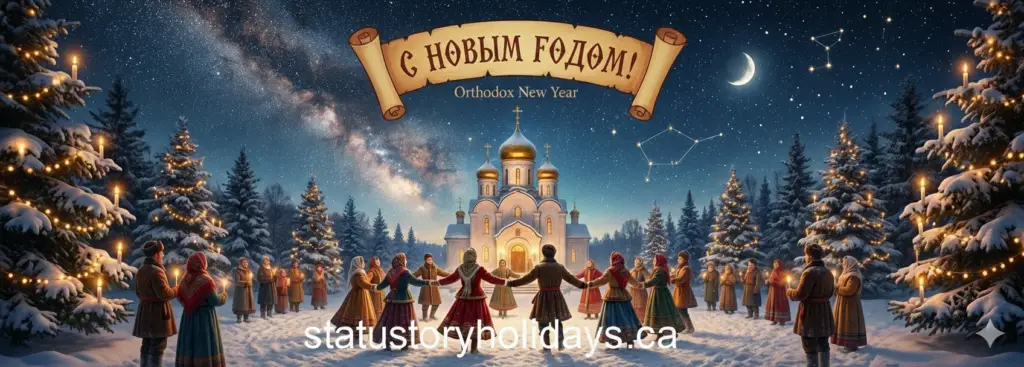
Orthodox New Year 2026—often called the Old New Year—is celebrated on January 14 by millions of Orthodox Christians around the world and throughout Canada. Although not a statutory holiday in Canada, it remains a deeply meaningful cultural and religious observance for Ukrainian, Russian, Serbian, Macedonian, Georgian, Romanian, Moldovan, and Greek Orthodox communities.
This celebration is rooted in the Julian calendar, which is currently 13 days behind the widely used Gregorian calendar. As a result, the traditional New Year observed by many Orthodox churches falls on January 14 on today’s modern calendar.
In this comprehensive guide, we explore the history, significance, customs, church traditions, food, and modern Canadian celebrations of Orthodox New Year 2026. This article is designed for both cultural interest and educational purposes, as well as for newcomers who want to better understand this beloved winter tradition.
What Is Orthodox New Year?
Orthodox New Year is the celebration of the beginning of the new year based on the Julian calendar. While most of the world follows the Gregorian calendar, associated primarily with Western Christianity and civil usage, several Eastern and Oriental Orthodox churches continue to observe religious dates using the older Julian system.
For this reason, their New Year’s Day—January 1 in the Julian calendar—falls on January 14 in the Gregorian calendar. This difference has created the term “Old New Year,” which combines historical tradition with a modern understanding of calendar divergence.
Today, Orthodox New Year is a mix of cultural celebration, religious reflection, and community gathering. For many families, it is considered a fresh start following the Christmas season, accompanying prayer, festive meals, and social visits.
Who Celebrates Orthodox New Year in Canada?
Canada is home to a large and diverse Orthodox population. Immigrant communities from Eastern Europe, the Balkans, the Middle East, and parts of Africa have brought their traditions with them, enriching Canada’s multicultural landscape.
Groups that traditionally observe Orthodox New Year include:
- Ukrainian Orthodox Christians
- Russian Orthodox Christians
- Serbian Orthodox Christians
- Macedonian Orthodox Christians
- Montenegrin Orthodox Christians
- Georgian Orthodox communities
- Romanian and Moldovan Orthodox Churches
- Some branches of Greek and Bulgarian Orthodoxy, depending on local tradition
These communities have long-standing churches, cultural organizations, and social clubs across Canada, especially in cities such as Toronto, Montreal, Winnipeg, Edmonton, Vancouver, Calgary, Saskatoon, and Hamilton. Many of these groups host festive events for the Orthodox New Year, creating intergenerational traditions that continue year after year.
History of Orthodox New Year
The roots of the Orthodox New Year stretch back to the Roman Empire. The Julian calendar, introduced by Julius Caesar in 46 BCE, served as the primary calendar throughout Europe for over 1,600 years. For centuries, this system worked well enough, but it gradually fell out of alignment with astronomical events such as the spring equinox.
By the 16th century, the discrepancy had grown to 10 days. In response, Pope Gregory XIII introduced the Gregorian calendar in 1582 to correct this shift. Many Catholic countries adopted it quickly, but Orthodox nations retained the Julian calendar for religious purposes.
Today, the discrepancy between the two calendars has increased to 13 days, creating the modern placement of the Orthodox New Year on January 14.
Why January 14 Matters
For Orthodox Christian communities, January 14 marks:
- The start of a new year in the Julian calendar
- The Feast of St. Basil the Great, a major Orthodox saint
- The continuation of the Nativity and Theophany season
- A time of prayer, thanksgiving, and reflection
This dual significance—both cultural and religious—makes the Orthodox New Year unique among winter observances.
Orthodox New Year 2026: Date and Significance
In 2026, Orthodox New Year falls on Wednesday, January 14.
While the date remains the same annually, its placement in the Gregorian calendar maintains the 13-day offset. This is why it follows after Christmas for many Orthodox communities, particularly those who celebrate Orthodox Christmas on January 7.
Orthodox New Year is not an official public holiday in Canada, meaning schools and businesses remain open. However, many families observe the day with:
- Church liturgies
- Family dinners
- Traditional foods
- Visiting relatives
- Festive singing and dancing
- Cultural community celebrations
Religious Traditions of the Orthodox New Year
1. Church Services
Many Orthodox believers begin the day with a special liturgy. This may include:
- Prayers of thanksgiving for the previous year
- Prayers for health, peace, and prosperity for the new year
- Chanting of traditional hymns
- The veneration of icons
The Feast of St. Basil the Great, a highly respected theologian and bishop, is also commemorated on this day. His teachings on charity, humility, and community service remain important pillars of Orthodox spiritual life.
2. Blessing of Homes
Some parishes conduct home blessings during the first two weeks of January. The priest visits households, offering prayers and sprinkling holy water to welcome the new year.
3. Candle Lighting
Candles symbolizing divine light are often lit at home or in church. Families may gather around the table for a prayer before the festive meal.
Traditional Foods Served on Orthodox New Year
Food plays a central role in Orthodox celebrations, with many dishes rooted in centuries-old customs. Although variations exist between cultures, several foods commonly appear on the Orthodox New Year table:
- Kutya – a ceremonial dish made of wheat, honey, and poppy seeds
- Pierogi / varenyky – stuffed dumplings popular among Ukrainian and Polish communities
- Borscht – beet soup often served hot in winter
- Banitsa (Bulgaria) – filo pastry with cheese, sometimes containing lucky charms
- Sarma – cabbage rolls with rice and meat
- Roast meats – pork, lamb, or chicken, depending on regional tradition
- Fresh bread and sweet loaves – symbolizing abundance
In some cultures, special breads like Vasilopita (St. Basil’s bread) contain a hidden coin. The person who receives the coin is believed to be blessed with good fortune for the coming year.
How Orthodox New Year Is Celebrated in Canada
Canadian Orthodox New Year celebrations blend tradition with modern Canadian multicultural life. Across the country, communities host:
- Folk dance performances
- Live music with accordions, violins, and traditional instruments
- Church dinners with homemade dishes
- Cultural festivals organized by community centres
- Family gatherings featuring food and games
- Charity events and fundraising dinners
Many Orthodox families also use the day to visit elderly relatives, offering respect and goodwill for the year ahead.
Orthodox New Year and Canadian Multiculturalism
Observances such as the Orthodox New Year highlight Canada’s commitment to cultural diversity. These traditions contribute to the country’s rich cultural fabric, allowing generations to maintain connections with their heritage while celebrating in a Canadian context.
Canadian institutions often acknowledge Orthodox holidays by sharing messages of goodwill, hosting educational events, or promoting community activities.
The celebration of the Orthodox New Year also provides an opportunity for non-Orthodox Canadians to learn about Eastern Christian traditions, from liturgical music to festive cuisine.
Is Orthodox New Year a Holiday in Canada?
No, Orthodox New Year is not a statutory holiday in Canada. Schools, workplaces, and government offices remain open. However, many families participate in evening celebrations, and some employers accommodate employees who observe the day.
To see actual statutory holidays by province, visit the Statutory Holidays Canada homepage.
Fun Facts About Orthodox New Year
- The term “Old New Year” is commonly used in Eastern Europe to describe January 14 celebrations.
- Some cultures celebrate both New Year’s Days—January 1 (Gregorian) and January 14 (Julian).
- In Serbian tradition, the Orthodox New Year is celebrated with fireworks and open-air events.
- In Macedonia, bagpipe music and folk dancing are common during the night festivities.
- The Julian calendar will eventually fall even further behind unless corrected.
Orthodox New Year 2026: A Day of Heritage and Community
For the more than one million Canadians with roots in Orthodox Christian countries, the Old New Year is more than just a calendar observance—it is a connection to ancestry, faith, and cultural identity.
Whether celebrated with quiet reflection, a church service, or a lively cultural gathering, Orthodox New Year 2026 offers an opportunity to honour the past while welcoming the future.